

Master the Balance: Your 2-Hour Study Schedule for Success After a 9-5 Job
Balancing a full time work and online learning is undeniably difficult. If you’ve ever felt like getting any quality studying done after working 40 or more hours a week is a struggle, you are not alone. In fact, nearly 40% of undergraduate students in the United States hold full-time jobs. While tackling a demanding career and academic goals requires immense planning, dedication, and time management, it is absolutely possible to succeed.
This comprehensive guide breaks down the struggle of the employed student and provides a structured, efficient 2-hour study schedule designed to maximize learning and minimize burnout after your 9-5 shift. By combining strict time management, focused sessions, and essential self-care tips, you can transition from “desk to degree” and actually see results.
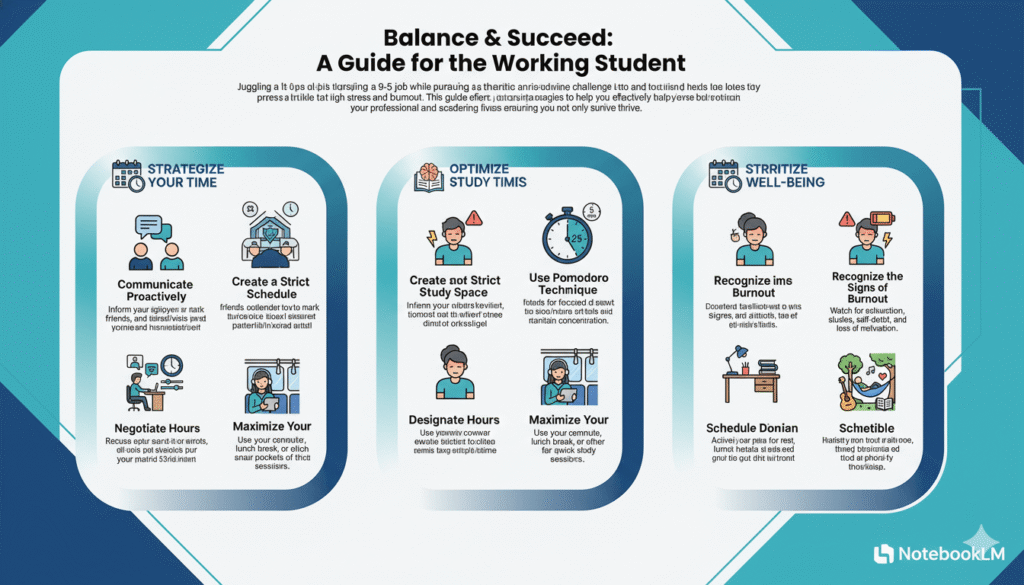
The Unique Challenges of the Working Student
Before diving into the schedule, it’s vital to recognize the specific hurdles that students balancing work and education face. Students often decide to work due to financial pressures, such as meeting living conditions or paying high scholarship fees. However, this juggling act introduces significant stressors.
The Risk of Academic Burnout
When trying to meet the demands of both professional and academic life, students are at a higher risk of stress and burnout. Studies have shown that this stress can lead to depression and other psychological disorders.
A key finding among employed students is that academic burnout is often higher than work-related burnout. This academic burnout—characterized by feeling exhausted by study demands, having a cynical attitude toward studies, and feeling incompetent as a student—is an effective and direct predictor of academic maladjustment.
Students who experience high levels of academic stress may miss classes, lose motivation, and even consider dropping out of college.
Furthermore, combining the student and employee roles diminishes an individual’s capacity to manage time and energy efficiently, increasing the risk of burnout.
The Anxiety and Cognitive Load
For many students, high levels of test anxiety explain high levels of academic burnout, which then explains poor academic adjustment. This anxiety, defined as a feeling of fear, tension, and worry during exams, can negatively affect academic performance and attention span.
Interestingly, research suggests that the type of work schedule might affect specific cognitive difficulties. Students with part-time jobs may experience higher cognitive impairment—difficulty regulating cognitive processes like memory and attention—compared to students with full-time jobs.
This result implies that structured schedules and organization are crucial for maintaining mental clarity.
The Time Barrier
Beyond the mental and emotional toll, time is the single biggest logistical barrier. Even when organizations offer tuition assistance (TA) programs—which are widely viewed as valuable tools for upskilling and retention—a massive 45% of employees report that they do not feel they have enough time to pursue education while working. This is why structuring your limited evening time is so essential.
The Core Framework: Your 2-Hour Study Schedule
This structured 2-hour schedule is designed specifically for professionals working a 9-5 job, starting right after the typical workday concludes. Remember that this routine is a guide, and you should feel free to adjust the timings and components based on your personal energy levels and preferences. Consistency, however, remains the key to seeing results.
Phase 1: Settle In and Prepare (6:00 PM – 6:15 PM)
Dedicate the first fifteen minutes to establishing a productive environment.
- Prepare Your Space: Start by preparing a study area that is clean, well-lit, and completely free from distractions.
- Gather Materials: Collect everything you will need—books, notebooks, laptop, etc.—before the session begins.
- Refuel: Grab a light snack or beverage to keep your energy up during the session.
Phase 2: Set Clear Goals (6:15 PM – 6:30 PM)
Spending a few minutes defining what you want to achieve helps create a focused mindset and allows you to track progress efficiently.
- Define Objectives: Set clear, achievable goals for the session. This might involve completing a specific number of exercises, mastering a particular concept, or making measurable progress on a project.
- Prioritization: Identify the most challenging topic you plan to tackle first, setting a productive tone.
Phase 3: Focused Study Session 1 (6:30 PM – 7:10 PM)
This first 40-minute block should focus on the heavy lifting.
- Tackle the Tough Stuff: Begin with the subject or task that requires the most mental energy or is the most challenging. Your mind is freshest earlier in the study period.
- Use Focused Intervals: Consider using a time management method like the Pomodoro Technique (25 minutes of focused work followed by a 5-minute break) to maintain concentration during this session.
Phase 4: Refresh and Reinvigorate (7:10 PM – 7:20 PM)
A 10-minute break is crucial to prevent burnout and refresh your mind.
- Step Away: Take time to step away from your study materials completely.
- Movement and Hydration: Use this time to stretch, hydrate, or do a quick meditation. Light physical activity can reinvigorate your focus and keep your mind sharp.
Phase 5: Focused Study Session 2 (7:20 PM – 8:00 PM)
The second 40-minute session continues your efforts, often using more interactive methods.
- Switch or Sustain: Continue with your next set of tasks or switch to a different subject to keep your mind engaged.
- Active Engagement: Apply different, effective study techniques, such as summarizing information, creating flashcards, or teaching what you’ve learned to an imaginary audience. Active engagement with the material is vital for deeper understanding and long-term retention.
Phase 6: Review and Plan (8:00 PM – 8:15 PM)
The last fifteen minutes wrap up the session and set the stage for tomorrow.
- Review and Reflect: Spend ten minutes reviewing what you learned and assessing whether you met your initial goals. Note any challenging areas that will require additional attention in the future. This step solidifies the knowledge gained.
- Plan the Next Session: Quickly jot down the topics you plan to cover in your next study session. This ensures you can hit the ground running the next time you sit down to study.
Post-Study: Relaxation Time (After 8:15 PM)
After such an intense study session, it is essential to give your brain time to unwind. Engage in enjoyable activities, like watching a favorite show, spending time with family or friends, or reading for pleasure. Integrating relaxation is crucial for promoting mental wellness and maintaining a healthy work-life balance.
Advanced Techniques for Maximum Retention
To ensure that your two hours are highly productive, employ study methods that enhance focus and retention.
Harnessing the Pomodoro Technique
The Pomodoro Technique involves breaking work into fixed time intervals—typically 25 minutes of focused work followed by a 5-minute break. Research suggests that this method, with its structured breaks, helps students stay focused, motivated, and reduces mental fatigue, outperforming self-regulated breaks. Other variations include the 52/17 rule (52 minutes work, 17 minutes break), or 50 minutes of study followed by 10 minutes of rest.
The Power of Active Recall
Passive reviewing of materials is less effective than active retrieval. Techniques for active recall include:
- Flashcards and Quizzing: Creating flashcards or using retrieval practice apps (which often employ spaced repetition) forces you to actively pull information from memory, reinforcing learning.
- Summarization and Teaching: Summarizing information in your own words, or teaching what you’ve learned to an imaginary audience, solidifies your understanding. The Feynman technique, for instance, emphasizes understanding concepts thoroughly by teaching them to others.
- Practice Tests: Regularly testing yourself helps identify areas needing further review and boosts memory recall, especially for subjects like STEM where application is key.
Environmental and Mental Optimization
To make the most of your focused blocks:
- Digital Detox: Turn off your phone and minimize digital distractions during study hours. Having a dedicated, distraction-free study space signals to your brain that it is time to focus.
- Change Scenery: Switching locations during study breaks, moving from a library to a cafe or another room at home, can stimulate creativity and retention.
- Block Scheduling: Organizing your day into time blocks dedicated to specific tasks minimizes distractions and allows for deeper concentration.
Integrating Work, School, and Flexibility
Succeeding as a working student requires flexibility, especially concerning your work and school environment.
Utilizing Asynchronous (Online) Learning
Online or asynchronous learning is highly favored by busy professionals because it makes time management easier.
- Self-Paced Access: Asynchronous learning provides on-demand access to content from anywhere at any time, making it ideal for busy professionals and global teams. Learners can move through material at their own speed, reducing stress.
- Retention: Online courses are easy to take in chunks, which aids retention. Research suggests that e-learning programs can reduce learning time by up to sixty percent.
- Equitable Solutions: Online courses offer a more equitable solution for deskless and hourly workers, who might typically struggle to access training or professional development.
While online learning offers flexibility, it can limit connections with co-workers compared to real-time sessions, and may not be suited for situations requiring immediate adaptation or high variability in skills that require instructor one-on-one attention.
Negotiating for Time and Support
Since a lack of time is a primary challenge, leveraging workplace support is crucial.
- Communicate Your Goals: Inform your employer and support network (friends, family) that you are enrolled in a degree program. Many workplaces appreciate the effort and may be surprisingly flexible.
- Seek Flexible Working Hours: Ask your employer for flexible scheduling or accommodations, especially for exams or major assignments. Studies show organizations should offer flexibility in work schedules and time off for classes to support employees’ education goals.
- Make a Detailed Plan: If requesting flexible hours, prepare a detailed plan outlining your proposed schedule and how it will work, taking into account recurring meetings and company rules.
- Highlight Benefits to the Company: When negotiating, emphasize how flexible hours could positively impact your work, such as making you less stressed and more focused, or allowing you to cover queries of clients overseas by starting early.
- Look into Tuition Assistance (TA): If your employer offers TA benefits, inquire about tuition reimbursement opportunities. Organizations are advised to ensure their TA programs include flexible options like hybrid degrees and self-paced courses, and that managers are supportive of educational pursuits.
Maximizing Every Minute
If you are working a 9-5 and don’t have time for multi-hour library sessions, maximize your downtime. Study during your commute on public transportation, or utilize your lunch break as a focused study block. Carrying flashcards to use during several 5-minute intervals throughout your day can help you chip away at material slowly but consistently. If possible, consider optimizing your vacation time to dedicate headspace to preparing for a major exam or project.
The Crucial Art of Self-Care and Balance
Working hard at your job and your studies is necessary, but taking care of yourself is equally vital.
- Prioritize Relaxation: Scheduling time for relaxation post-study promotes mental wellness and helps you unwind. Neglecting this downtime, especially after intense study, can lead to chronic stress.
- Be Present: When studying, focus entirely on academics; when working, focus entirely on your job. Trying to stress about your exam while at work or scrolling through social media while studying is counterproductive and increases the feeling of being hectic.
- Set Realistic Goals: If you are working 40 or more hours weekly, setting the expectation of full-time enrollment may be too lofty and could lead to burnout. Be adaptable and flexible with your plans to manage unexpected obstacles.
- Recognize Burnout Symptoms: Be alert for signs of burnout, which can include feelings of self-doubt, detachment, loss of motivation, or an increasingly negative worldview. If these appear, reevaluate your study load and time management.
- Celebrate Progress: Don’t wait until graduation to acknowledge your dedication. Celebrate small wins, like passing a difficult exam or submitting a challenging assignment on time, to maintain motivation.
Achieving success while balancing full-time work and academic goals relies on a combination of structure, preparation, and consistent self-care. By implementing this efficient 2-hour study schedule and integrating flexibility and mental wellness into your routine, you can master your time and thrive on your journey to further education.